


Below are few selected books that have made a real impact on me and I’d really recommend them for further reading into the science behind a lot of what we do here at storyMAKERS. Hopefully you find them as useful as I have done.
Research

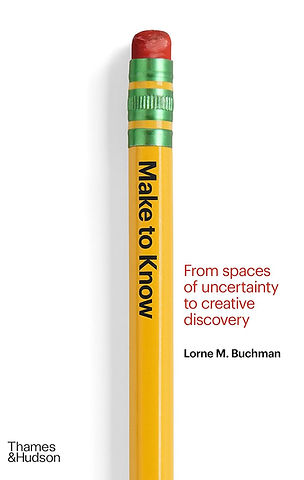
Make to Know: From Spaces of Uncertainty to Creative Discovery
by Lorne M. Buchman
One of my absolute faves! If I could quote the entire book here I would, but I’d recommend just to read it yourself. Make to Know is everything storyMAKERS is all about - that we learn through making, that getting started shouldn’t be the barrier that we (or our children) experience it as, and that it is the misconceptions woven into our very culture about what it is to be creative that have made it feel so out of reach for most people. the majority of makers I have interviewed for this book do not see their work as the product of predetermined vision. Instead, the recognise that what they produce evolves from the process of making itself Marjorie Garber "if we remind ourselves that what is really at stake is creativity and invention; if we can learn to separate the power of ideas from that of personality; then perhaps we will be...less distracted by attempts to lionize the genius as a high-culture hero we begin our creative journeys by entering uncertainty, a space brimming at once with opportunity and intimidating emptiness Discovery is not fundamentally something we can control; we can only construct circumstances for its realisation. "to me the writing is a process of failing, failing, failing forward until hopefully I have something" The importance of considering another - developing the "empathy muscle", as some designers like to say - is indisputable What artists and designers come to know in the making is not only what the work itself needs to be, but often something about themselves and how they think or feel about a given idea, question or struggle. improvisation, and make to know generally, perhaps counterintuitively does not and cannot transpire without structure or context

Creative Schools
by Ken Robinson
An incredible book written by a man who clearly cares very deeply about children and about his subject. All his books are great but this one is my favourite. It takes you into the nitty gritty of why we have prioritised ‘academic’ development over creative development and, basically, the mess we’re in because of it. Again, I’ll struggle breaking it down into a few quotes but I’ll try…. MY FAVOURITE QUOTES Traditional teaching is focussed on teaching facts and information through direct instructions to the whole class Of course, academic work is important in itself, and theory can and should inform practice in all areas of life. But in the conventional academic curriculum, the emphasis is squarely on the former rather than the latter. Academic studies are unquestionably essential and should form part of every student’s education. But they are not enough. They are necessary but not sufficient to the sort of education that all students now need. Nothing that we do, no amount of toys we buy or 'quality time' or special training we children, can compensate for the freedom we take away. The things that children learn through their own initiatives, in free play, cannot be taught in other ways.. There are various myths about creativity. One is that only special people are creative, another is that creativity is only about the arts, a third is that creativity cannot be taught, and a fourth is that it's all to do with uninhibited "self-expression." None of these are true. Creativity draws from many powers that we all have by virtue of being human. Creativity is possible in all areas of human life, in science, the arts, mathematics, technology, cuisine, teaching, politics, teaching, you name it. And like many human capacities, our creative powers can be cultivated and refined. Focussing on skills in isolation can kill any interests in any discipline” “If you don’t trust kids to be natural learners, you’re not going to get there”

Your Brain on Art: How the Arts Transform Us
by Susan Magsamen & Ivy Ross
This book was a bit of a game changer for me. It took what I had already guessed through my own experience of creativity and made it science. By the end of this read you’ll want to head straight to the pen box and start doodling yourself! It’s impossible to narrow down into a few short quotes but it's an essential read if you really want to get to grips with the benefits of art education. MY FAVOURITE QUOTES Arts and aesthetics can quite literally rewire your brain. They are a secret sauce that helps build new synaptic connections the ultimate enriched environment is nature Becoming aware of what you like and don't like, and better understanding how you are influenced, informed, and changed by art encounters, creates opportunities for you to apply your own perceptual preferences to almost every area of your life The brain is a meaning-making machine in that it wants us to connect the dots, find patterns and understand, and then build neural pathways accordingly what we cognitively think and what we biologically feel don’t always align drawing, by changing brain-wave activity and increasing blood-flow to the frontal regions of the brain, has a positive effect of our psychological resilience Learning doesn't happen simply by absorbing what's coming at you. It's tactile. Its making. Learning is experimental

Flow: The psychology of Optimal Experience
by Mihaly Csikszentmihalyi
I listened to the audiobook of Flow during the long long walks that I like to do. But I’ve had to listen twice as only the general gist went in the first time. This book is breakthrough-stuff - it’s where much of my ideas about motivation, challenge and resilience come from - but its also quite dense and there’s a lot of information in there. MY FAVOURITE QUOTES The best moments usually occur when a person’s body or mind is stretched to its limits in a voluntary effort to accomplish something difficult and worthwhile But in the long run optimal experiences add up to a sense of mastery, or perhaps better, a sense of participation in determining the content of life that comes as close to what is usually meant by happiness as anything else we can conceivably imagine.” in flow there is no room for self-scrutiny When not preoccupied with ourselves, we actually have a chance to expand the concept of who we are. Loss of self-consciousness can lead to self-transcendence, to a feeling that the boundaries of our being have been pushed forward.

Drive: The Surprising Truth About What Motivates Us
by Daniel Pink
This book started my obsession with ‘intrinsic motivation’ being a cornerstone of what it means to be creative. If I remember rightly (I read it a while ago now), it contained a few too many anecdotes about famously driven people, but still a really interesting and useful read if you want to get to grips with motivation. Human beings have “an inherent tendency to seek out novelty and challenges, to extend and exercise their capacities, to explore and to learn” but this third drive is more fragile…it needs the right environment to survive. rewards and punishments—both carrots and sticks—can work nicely for algorithmic tasks. But they can be devastating for heuristic ones RYAN - If theres anything (fundamental) about our nature, its the capacity for interest. Some things facilitate it. Some things undermine it. (Dweck) the entity theory....is a system that requires a diet of easy successes". In this schema, if you have to work hard, it means you're not very good. People therefore choose easy targets that, when hit, affirm their existing abilities but do little to expand them. In a sense, entity theorists want to look like masters without expending the effort to attain mastery.

Inspiration: Where the Best Ideas Come From
by AP Dijksterhuis, 2025
This book was where I got all my information about the myth that is the "eureaka" moment and about inspiration generally...obviously. Its a fascinating read and really challenges our notions about what ideas actually are and what it takes to ‘get’ them. I use his concepts a lot in my classes - that we cannot just expect ideas to magically come to us and its important life lesson to know what to do to draw them out of our subconscious. A great read if you want to help with the ‘blank paper’ avoidance issue. MY FAVOURITE QUOTES The bad news is that nothing will come of nothing. Inspiration is far from free. It demands perspiration Inspiration feels good. It’s accompanied by positive emotions and has even been compared to falling in love. This increases the likelihood that a person will act on their inspiration, in the hope of retaining those positive emotions....inspiration increases your stamina. its best not to provide rewards for things that are inherently fun

The Cambridge Handbook of Creativity
by Ken Robinson
So not exactly a pool-side read but helpful for a less anecdotal spin on creativity, if this is what you’re after. This book provides a sort of summary on all the research around creativity, of which there is lots. Whilst I have naturally forgotten all the names of these famous researchers, I got a lot out of understanding how the study on creativity has developed over the years. Every human has the genetic background that makes creativity possible creativity is not an inherited ability that’s fixed at birth. It comprises a set of skills and attitudes that all people can develop The selling of ideas is an important part of the practical element of creative thinking Almost every significant discovery involved some degree of risk. In sum, creativity is in large part a decision - a set of attitudes towards life - that teachers and parents can encourage in students or in themselves unless people value creativity, they will likely not engage in creative behaviours Teaching ABOUT creativity; teaching FOR creativity; and teaching WITH creativity

The Artist's Way
by Julia Cameron, 1992
I’d read this book before I’d even started storyMAKERS. It’s pretty famous - probably because of the way it speaks to us normal people. A lot of books I read written by eminent cognitive scientists or researchers talk about a form of creativity that I barely recognise (and am not interested in). Julia talks about creativity, and art, in terms of the everyday - how its the small bits of ‘art’ we do that change our life. It can be a bit god-focussed, which isn’t so much my thing, but it's easy to interpret from a god-free perspective too. MY FAVOURITE QUOTES Leap and the net will appear Perhaps the greatest barrier for any of us as we look for an expanded life is our own deeply held skepticism. The reason we think it's weird to imagine an unseen helping hand is that we still doubt that it's okay for us to be creative People frequently believe the creative life is grounded in fantasy. The more difficult truth is that creativity is grounded in reality, in the particular, the focused, the well observed or specifically imagined. As we lose our vagueness about our self, our values, our life situation, we become available to the moment. Art is not about thinking something up. It is the opposite—getting something down Only when we are being joyfully creative can we release the obsession with others and how they are doing
Other books
Jonathan Haidit, The Anxious Generation
Catherine Price, The Power of Fun
Dr Tina Payne Bryson, Dr Daniel Siegel, The Whole Brain Child
Will Storr, The Science of Storytelling
Jill Anderson, Letting Go of Perfect
Other resources


The Future of Jobs Report 2025 https://reports.weforum.org/docs/WEF_Future_of_Jobs_Report_2025.pdf
Child of the North / Centre for Young Lives Art & Creativity Report 2025
https://www.n8research.org.uk/media/CotN_Arts-Creativity_Report_12.pdf
Children and Young People's Writing in 2025, Literacy Trust
https://nlt.hacdn.org/media/documents/Children_and_young_peoples_writing_in_2025_nCYHDaM.pdf
Mental Wellbeing, Reading and Writing, Literacy Trust
I am always looking to expand my knowledge and understanding.
If you have any relevant research you would like to share, please do email it over,
I'd very much like to hear about it.
Thank you